If you’ve ever seen someone drop “brb, RLS” in a group chat and wondered whether they were quoting a secret code, you’re not alone. The RLS meaning changes depending on where you see it — a text thread, an Instagram caption, a doctor’s office, or even a line of database code. And honestly? That’s part of the fun. Few three-letter acronyms carry this many completely unrelated lives at once.
In this guide, we’re breaking down every major RLS meaning in plain, friendly language — no jargon, no confusion, just clear answers you can actually use. Whether you’re trying to decode a text from a friend, write a witty caption, or simply satisfy your curiosity, you’ll walk away knowing exactly which RLS meaning applies and when.
Let’s get into it.
What Does RLS Mean? A Quick Answer
Before we go section by section, here’s the short version: RLS most commonly means “Real Life Stuff” or “Real Life Situation” in texting and social media slang. But depending on the context, it can also mean Restless Legs Syndrome (a medical condition), Row-Level Security (a data and tech term), or a handful of smaller, niche meanings.
The trick isn’t memorizing every definition — it’s learning how to spot which one applies. That’s exactly what this guide is built to teach you.
The Most Popular Meaning: RLS as “Real Life Stuff”
This is the meaning you’ll bump into the most, especially if you spend time in group chats, Discord servers, or comment sections. Understanding this version of RLS instantly makes a huge chunk of online conversation make sense.
Where This Slang Term Came From
Online communities have always needed shorthand for stepping away from a screen. Early internet slang gave us AFK (“away from keyboard”), but as digital life became more woven into everyday life, people needed something that signaled more than just a quick break — they needed a reason. That’s where RLS stepped in.
Unlike AFK, which simply says “I’m not at my keyboard,” RLS implies there’s an actual obligation pulling someone away — work, family, errands, or anything happening outside the screen. It’s less “I’m busy” and more “life is happening, and I have to deal with it.”
Example Texts Using RLS
Here’s how this meaning typically shows up in real conversations:
- “Can’t stream tonight, dealing with some RLS 😅”
- “Sorry for the late reply, RLS has been wild this week”
- “Taking a short break for RLS, back in an hour”
- “Missed the call because of RLS, my bad!”
- “RLS is kicking my butt today, talk later”
Notice the pattern — it’s almost always used as a reason or an excuse, not as a standalone noun. You wouldn’t say “I love RLS.” You’d say “I’m dealing with RLS.”
RLS on Instagram and TikTok: “Real Life Stories”
Social platforms love putting their own spin on abbreviations, and RLS is no exception. On Instagram especially, this acronym has picked up a slightly different, more content-focused meaning.
How Creators Use the RLS Hashtag
On Instagram, RLS often stands for “Real Life Stories.” Creators use it as a hashtag or caption tag to flag their most candid, raw moments — the ones that skip the usual polish of a highlight-reel post. Think candid selfies, messy kitchens, no-makeup selfies, or honest life updates — the opposite of a picture-perfect feed.
This usage reflects a broader shift in social media culture: people are increasingly craving authenticity over curated perfection, and tags like #RLS give them a simple way to signal “this one’s real.”
Sample Captions Using This RLS Meaning
- “No filter, no edits — just #RLS today”
- “This is what my actual Monday looks like #RLS”
- “Sharing the messy parts too #RealLifeStories #RLS”
- “Behind the scenes, no aesthetic required #RLS”
If you see RLS attached to a candid, everyday photo rather than a polished shot, this is almost certainly the meaning in play.
RLS in Medical Terms: Restless Legs Syndrome
Step outside of texting and social media, and RLS takes on a completely different, more formal identity. In healthcare conversations, RLS almost always refers to Restless Legs Syndrome, a well-documented neurological condition.
What Restless Legs Syndrome Is
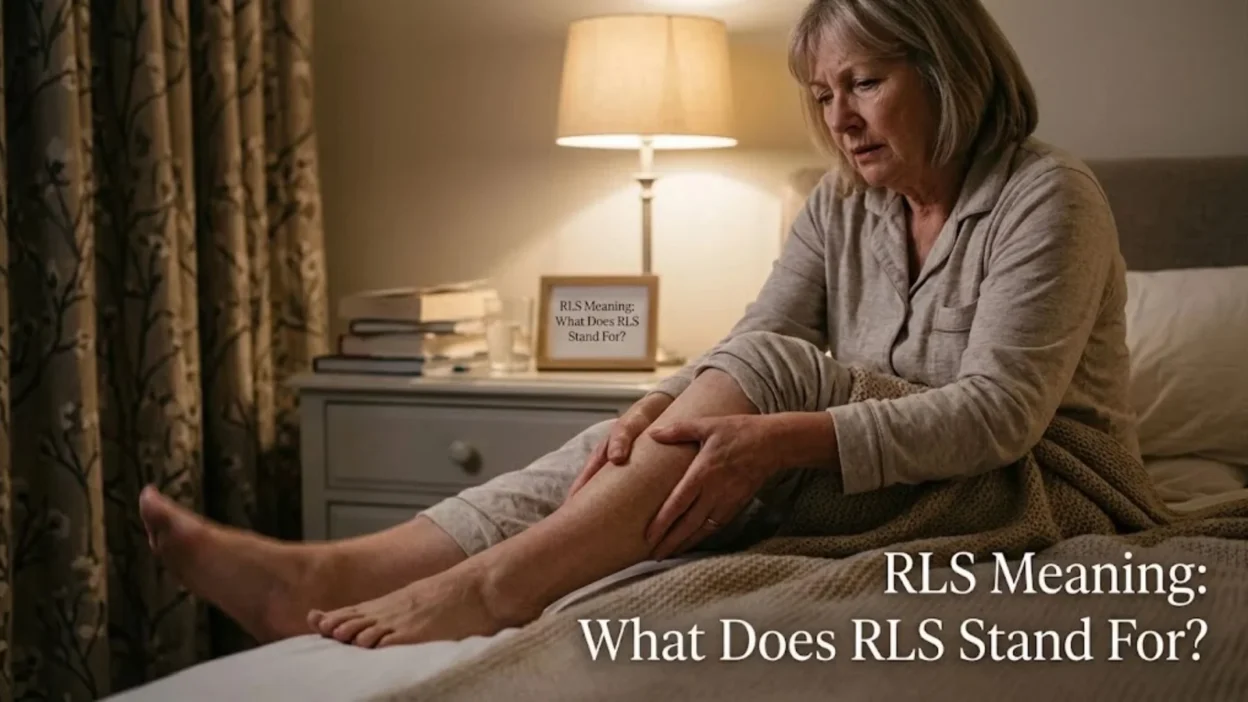
Restless Legs Syndrome is a condition that causes an uncomfortable urge to move the legs, and people often compare the feeling to crawling, tingling, or aching. It tends to show up during periods of rest, particularly in the evening or at night, which can make it harder to fall asleep or stay comfortable.
Doctors, researchers, and health organizations widely recognize and discuss this medical term, and you’ll encounter it in medical articles, symptom checklists, and health forums. If you’re researching sleep issues or leg discomfort and come across “RLS,” this definition very likely applies.
When the Slang and the Medical Meaning Get Mixed Up
This is where things can get genuinely confusing. Imagine searching “RLS meaning” while trying to understand a health symptom, only to land on an article explaining internet slang about texting excuses. Frustrating, right?
The good news is that context almost always makes the difference obvious. Medical content will typically pair RLS with words like symptoms, sleep, legs, discomfort, or condition. Slang usage pairs it with words like chat, stream, busy, or reply. If you’re ever unsure, glance at the surrounding words — they’ll tell you everything.
RLS in Tech and Data: Row-Level Security
Step into the world of databases and software, and RLS shifts identities once again. Here, it stands for Row-Level Security, a technical concept used to control who can see or edit specific pieces of data.
What Row-Level Security Actually Does
Database systems use Row-Level Security to restrict access to certain rows of data based on who’s requesting it. Instead of giving every user access to an entire table of information, RLS lets administrators set rules so that, for example, an employee can only view records tied to their own department, region, or account.
At its core, it’s a security and privacy tool — a way to keep sensitive data visible only to the people who need to see it.
Who Typically Uses This RLS Meaning
You’ll come across this definition most often in:
- Database administration discussions
- Software development documentation
- Business intelligence and reporting tools
- IT security training materials
If RLS shows up next to terms like database, permissions, query, or access control, you’re almost certainly looking at the tech definition rather than the slang or medical one.
Other Lesser-Known Meanings of RLS
Beyond the three big ones, RLS pops up in a few smaller, more specialized corners of language. These are far less common, but worth knowing if you ever stumble across them.
Royal Letters (Formal and Legal Use)
In certain formal or legal documents, “RLs” (lowercase plural) has historically referred to royal letters, particularly in older or ceremonial contexts. It’s rare in everyday writing but occasionally appears in historical or governmental references.
Recursive Least Squares (Engineering and Math)
In engineering, signal processing, and applied mathematics, RLS can stand for Recursive Least Squares, an algorithm used to estimate values and adjust calculations over time. This meaning lives almost entirely in academic papers, technical manuals, and engineering coursework — you won’t see it in casual conversation.
How to Tell Which RLS Meaning Is Being Used
With so many possible meanings, the real skill isn’t memorization — it’s context reading. Here’s how to quickly figure out which RLS meaning applies in any given moment.
Check the Platform First
Where you encounter the acronym is often the biggest clue. A text message or Discord chat almost always points to “Real Life Stuff.” An Instagram caption usually means “Real Life Stories.” A medical website or symptom article points to Restless Legs Syndrome. A tech forum or software manual points to Row-Level Security.
Look at the Sentence Structure
Pay attention to how the sentence uses RLS. If someone uses it as a reason (“because of RLS”), it’s likely the slang meaning. If it appears as a subject with symptoms attached (“RLS causes discomfort”), it’s the medical meaning. If technical verbs like “enable,” “configure,” or “apply” sit next to it, it’s almost certainly the tech meaning.
Once you get used to spotting these clues, decoding RLS becomes second nature.
Fun Ways to Use “RLS” in Captions and Bios
If you love casual online slang, RLS is a handy little tool for keeping captions and bios feeling relatable and low-key. Here are some ideas for putting it to good use.
Caption Ideas
- “Went quiet for a bit — RLS took over 📵”
- “Unfiltered, unplanned, unbothered #RLS”
- “This week has been 90% RLS, 10% sleep”
- “Real life > highlight reel #RLS”
Bio One-Liners
- “Currently buried in RLS, back soon”
- “Screen time low, RLS high”
- “Living the RLS life, one day at a time”
These work especially well if your online presence leans casual and personality-driven rather than polished and brand-heavy.
Common Mistakes People Make With RLS
Even once you know the different meanings, it’s easy to slip up. Here are the most common mix-ups worth avoiding.
Mixing Up Slang and Medical Meaning
Using “RLS” casually in a health-related conversation can cause genuine confusion, especially with someone unfamiliar with the internet slang version. If you’re discussing symptoms or sleep issues, it’s worth spelling out “Restless Legs Syndrome” at least once to avoid ambiguity.
Using RLS in Formal Writing
Slang abbreviations like RLS are great for texting and casual captions, but they don’t belong in formal emails, reports, or professional communication. In those settings, always default to full, clear wording rather than assuming your reader knows the shorthand.
RLS vs. Similar Acronyms: Don’t Get Them Mixed Up
Part of what makes RLS tricky is that it sits in a crowded neighborhood of similar-looking acronyms. Knowing how it differs from its lookalikes makes it even easier to use correctly.
RLS vs. IRL
IRL stands for “in real life” and typically works as a description, not a reason — as in “let’s meet up IRL.” RLS, on the other hand, works as an excuse or explanation, as in “sorry, dealing with RLS.” They’re cousins in meaning but play different grammatical roles in a sentence.
RLS vs. AFK
AFK (“away from keyboard”) simply tells someone you’re stepping away, without explaining why. RLS goes a step further by hinting that something real and important is pulling you away. Think of AFK as the polite pause button, and RLS as the reason behind it.
RLS vs. BRB
BRB (“be right back”) signals a short, often trivial break — grabbing a snack, answering the door for a second. RLS tends to imply something a little more significant or ongoing, which is why people often pair the two together, as in “brb, dealing with RLS.”
A Quick Look at How Acronyms Like RLS Spread Online
It’s worth pausing for a moment to appreciate how acronyms like RLS even come to exist in the first place. Online language evolves fast, and abbreviations spread through repeated, casual use rather than any formal decision.
Someone types a shorthand once in a chat. Others pick it up because it’s quick and efficient. Platforms and communities adopt their own flavor of the term based on how their users communicate — which is exactly why Instagram’s version of RLS (“Real Life Stories”) looks so different from the gaming and texting version (“Real Life Stuff”). Meanwhile, entirely separate professional fields — medicine, engineering, and technology — had already been using RLS for decades before internet slang ever got involved, which is part of why the acronym now carries so many layers of meaning.
Understanding this evolution isn’t just trivia — it explains why context matters so much. A dictionary doesn’t fix an acronym’s meaning; the community using it shapes that meaning at any given moment.
Why Knowing the Right RLS Meaning Actually Matters
It might seem like a small thing, but misreading an acronym can lead to real confusion, especially in mixed conversations. Picture a customer support chat where a user mentions “RLS issues” — a support agent needs to instantly know whether that means a login permissions bug (Row-Level Security) or something else entirely. Or imagine a health forum where someone casually drops “dealing with RLS” and a well-meaning reader assumes they mean a medical condition, when really they just meant a busy week.
Getting comfortable with all the possible meanings of RLS — and knowing how to read context clues — helps you communicate more clearly and avoid these small but genuinely awkward mix-ups.
Frequently Asked Questions About RLS Meaning
What does RLS mean in texting?
In texting and casual chat, RLS almost always means “Real Life Stuff” or “Real Life Situation” — a quick way to explain stepping away from a conversation for something happening offline.
Does RLS always mean Restless Legs Syndrome?
No. While RLS is a widely recognized medical abbreviation for Restless Legs Syndrome, it only carries that meaning in medical or health-related contexts. In texting, social media, or tech discussions, it means something entirely different.
How can I tell which RLS meaning someone is using?
Look at the platform and the surrounding words. Casual chats usually mean “Real Life Stuff,” Instagram captions usually mean “Real Life Stories,” health content usually means the medical condition, and tech or database discussions usually mean Row-Level Security.
Is it okay to use RLS in a professional email?
Generally, no. RLS works well in casual texting or social captions, but in professional or formal writing, it’s best to spell things out fully — “Row-Level Security” in a technical report, or a complete explanation in a workplace email — so your reader never loses the meaning.
Final Thoughts on the RLS Meaning
At the end of the day, RLS is proof that even a simple three-letter acronym can live several completely different lives depending on where it shows up. Whether you needed the RLS meaning for a confusing text, a caption idea, a health question, or a tech project, hopefully this guide cleared things up in a clear, friendly way.
Got a favorite way you use RLS, or another hidden meaning we didn’t cover? Drop it in the comments and share this guide with a friend who’s probably just as confused by internet acronyms as you were five minutes ago.

Emily Carter is a humor writer passionate about puns, witty jokes, and creating content that brightens your day.